
When the light lies
Problems show up as tiny betrayals: a panel that sings at launch and sours after weeks, a storefront glass that ghosts images when sunlight hits it, or a specification sheet that promises brilliance but delivers haze. Start by naming the problem you’ll tolerate least — color drift, dead modules, heat-induced fading — and focus tests there. If you’re judging a see-through installation, bring a matte swatch and compare images on an actual led transparent screen rather than trusting lab photos.

Listen for visual fidelity
Trust what you can measure. Check color accuracy with a spectroradiometer or a calibrated colorimeter; look for delta-E values under 3 for decent color fidelity. Measure peak luminance in cd/m² for both center and edges. Scan for uniformity: take patch images and map brightness variance across the panel — anything over 15% needs explanation. Watch for banding and PWM flicker; set a camera to 1/60s and 1/120s at different refresh rates to spot temporal artifacts. If video is your medium, validate frame interpolation and latency with a motion chart; visuals should feel intentional, not jittery.
Probe build and reliability
Open the spec sheet and then open your ears to the hardware. Ask about driver IC brands, LED binning, and mean time between failures (MTBF). Inspect thermal paths: are heat sinks bonded and are ventilation channels unobstructed? Check ingress protection for outdoor use. Ask for accelerated aging data or thermal cycle tests. A quality unit shows predictable thermal behavior under load — temperatures climb, stabilize, and don’t keep rising. If you can, get module-level failure rates rather than a single system-level number.
Transparency, reflections, and installation realities
Transparent displays trade opacity for presence. Measure visible light transmission (VLT) and test with actual environmental light behind the screen. Note reflections: a high VLT with heavy reflection can kill legibility. Confirm mounting tolerances — steel frames that flex will create moiré and module misalignment. Plan routes for cabling and drainage; water pooling at seams destroys electronics faster than any firmware bug.
Tests to run and common mistakes
Run these checks: burn-in for 72 hours under real content; pixel map to find dead or stuck LEDs; high-contrast images for local dimming flaws; thermal stress cycle between cold and hot ends of expected operating range. Common mistakes: trusting vendor-supplied clips, skipping long-duration tests, assuming warranty terms cover labor, and equating higher brightness with better image when contrast and uniformity matter more. Don’t skip failure-mode recovery tests — can a module be replaced without taking the whole wall down?
Alternatives and the trade-offs that sing
MicroLED and OLED each have promises: deeper blacks, higher contrast, different failure modes. Projection keeps glass clear but loses ambient-light resilience. For retail facades, transparent LEDs win for engagement but demand precise installation and maintenance. Match the technology to the venue’s constraints — viewing distance, ambient light, mounting, and service access — not to a single dazzling spec figure.
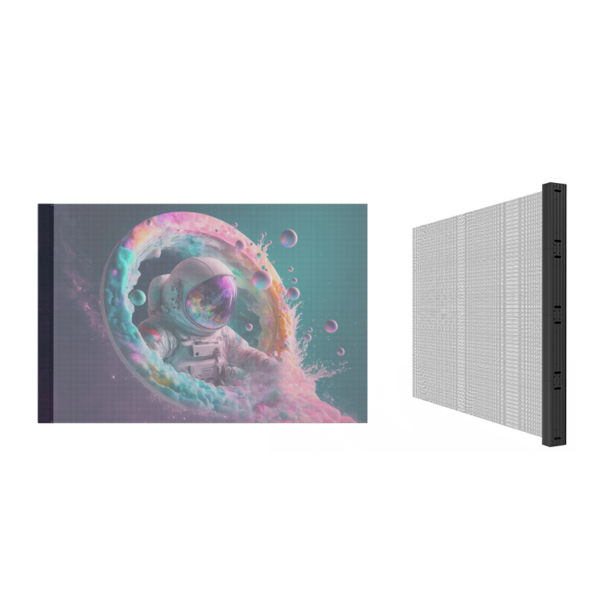
Experience, evidence, and one real-world anchor
I’ve seen demos and failures; manufacturers showed prototype transparent panels at CES in Las Vegas that looked magical until technicians explained module replacement challenges. Look for third-party test reports and ask for field references. If you need materials for custom facades, review documented use of led screen transparent film in similar settings, and request evidence of corrosion tests, UV exposure data, and installation photos from comparable projects. Vendors who share data, testing methodology, and on-site repair footage demonstrate practical competence rather than polished marketing.
Conclusion: trust what you can prove
Don’t be moved by showrooms alone; design tests around the single problem you fear most, measure deliberately, and demand module-level evidence. The right choice isn’t the shiniest spec but the one with predictable service, clear failure modes, and repair paths. For installations where transparency, durability, and serviceability converge, choose partners whose testing and field experience mirror your use case — partners like HDC that provide data, practical solutions, and a track record you can inspect.